Ingredient guide
Hyaluronic Acid for Skin: What It Is and What the Research Says
Also known as: Sodium hyaluronate, hyaluronan, HA · By the VitaUSA360 Editorial Team
Quick answer
Hyaluronic acid is a sugar-based molecule that binds large amounts of water, and it occurs naturally in skin. In creams and serums it is used as a humectant, a water-attracting ingredient that helps skin feel hydrated and look smoother. On a label it usually appears as sodium hyaluronate or hyaluronic acid, and it is generally well tolerated when applied to skin.
| Type of molecule | Glycosaminoglycan (long-chain sugar polymer) |
|---|---|
| Found naturally in | Skin, connective tissue, joint fluid and eyes |
| Role in skin care | Humectant: attracts and holds water |
| Common INCI names | Sodium Hyaluronate, Hyaluronic Acid, Sodium Acetylated Hyaluronate |
| Typical forms | Creams, serums, gels, masks |
| Usual cosmetic concentration | Often a fraction of a percent up to a few percent |
| Related ingredients | Niacinamide, peptides, glycerin, vitamin E |
What is hyaluronic acid, and what does it do for skin?
Hyaluronic acid (HA), also called hyaluronan, is a long, flexible chain of repeating sugar units. Your body makes it, and it is found in the skin, connective tissue, joints and eyes. In skin it sits between cells in the dermis, where one gram can bind a very large volume of water, which is why it is so closely linked with the feeling of plump, hydrated skin. The molecule is described in more detail in the Wikipedia article on hyaluronic acid.
The HA in cosmetics is made by bacterial fermentation, not taken from animals. Brands often use its salt form, sodium hyaluronate, which dissolves easily in water-based formulas.
Hyaluronic acid is a humectant. Applied to the skin surface, it draws water toward the outer layer and slows the loss of moisture, so skin feels softer and looks smoother and more even. Because dry skin makes fine lines look more visible, better hydration can make the skin’s surface look younger even though a cream is not changing deeper structures.
Skin makes less HA as we age, which is one reason it features in products for mature skin. It also pairs naturally with other ingredients: niacinamide supports the skin barrier, peptides target the look of expression lines, and emollients such as vitamin E seal moisture in.
Hyaluronic acid benefits backed by research
Several studies have looked at topical HA specifically:
- Hydration and elasticity. In a randomized study by Pavicic and colleagues, 76 women aged 30 to 60 with periocular (around-the-eye) wrinkles used creams with 0.1% hyaluronan of five different molecular weights on one eye area and a vehicle cream around the other. Over 60 days, all HA creams significantly improved skin hydration and elasticity compared with placebo (PubMed).
- Look of wrinkles. In the same study, the creams with lower molecular weight HA (50 and 130 kDa) were associated with a significant reduction in measured wrinkle depth after 60 days.
- Broader reviews. A review by Bukhari and colleagues of cosmetic and nutricosmetic studies concluded that HA-based gels and creams are associated with improved skin hydration, firmness and a smoother look, while noting the field includes many formulation types and research designs (PubMed).
The takeaway is that hydration is the strongest and best-documented benefit. Results depend on the formula, the molecular weight of the HA and how consistently it is used.
Molecular weight is a useful detail. Larger HA chains stay mostly on the surface, forming a light moisture-holding film, while smaller fragments are studied for how they interact with the upper skin layers. That is why you may see “multi-weight” or “low and high molecular weight” on a label: brands combine sizes to cover both surface and deeper hydration.

How is hyaluronic acid used in face and neck creams?
HA is a supporting actor in many anti-aging formulas. It is applied to clean skin, usually in the evening, so the water-binding effect is working while the skin rests. Formulators combine HA with active ingredients that smooth the look of lines, and with emollients that lock in moisture.
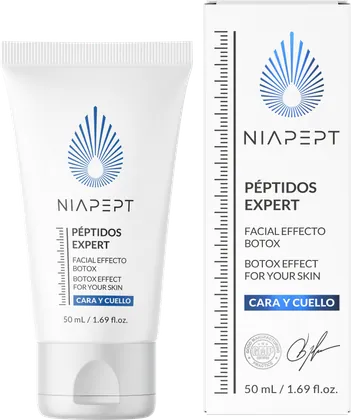
A fuller formula such as Niapept face and neck cream pairs hyaluronic acid with the cosmetic peptide Argireline and with niacinamide. For the bigger picture, see our article on peptides for skin and the guide to skin care after 50.
The neck deserves a mention of its own. The skin there is thin and has fewer oil glands than the face, so it tends to look dry and crepey sooner. Water-binding ingredients such as HA are a natural fit for this area, and applying a cream with upward strokes from the collarbone to the jaw is a simple habit that treats face and neck as one canvas. Apply sunscreen in the morning on top: HA moisturizes, but it does not replace sun protection.
How to spot hyaluronic acid on a label
Cosmetic labels use the standardized ingredient names known as INCI. The ones to look for are Sodium Hyaluronate (the most common), Hyaluronic Acid, Hydrolyzed Hyaluronic Acid and Sodium Acetylated Hyaluronate. The FDA requires ingredients in retail cosmetics to be listed generally in descending order of predominance, so a name near the top means more of it, and one near the end means a small amount (FDA).
Remember that hyaluronic acid in a cream is a cosmetic ingredient. It is a separate topic from oral hyaluronic acid products, which are sold as dietary supplements and are not what a skin cream contains.
Hyaluronic acid safety, side effects and interactions
Topical HA is generally well tolerated, and reactions are uncommon. As with any skin product, a rare person may notice redness, itching or stinging, often from another ingredient in the formula such as a fragrance or preservative. If you have sensitive or reactive skin, patch-test a small amount on the inner forearm for a day before using it on the face.
There are no well-known interactions between topical HA and medicines. Keep creams away from the eyes, stop use if irritation develops, and see a dermatologist for rashes that do not settle. Injectable fillers made from HA are medical procedures and are separate from skin-care creams.
Pairing is straightforward. HA works with most other skin-care ingredients, including niacinamide, peptides and vitamin E, and layering it under a heavier cream helps hold the moisture in. If you use prescription topical products, ask your dermatologist how to order them.
Which products we review contain hyaluronic acid?
Of the five products we cover, Niapept lists hyaluronic acid among its key ingredients, together with Argireline, niacinamide, calendula, vitamin E and aloe vera. Related ingredient guides: niacinamide, Argireline, aloe vera and calendula.
This guide is general information, not medical advice. Ask your doctor or pharmacist before starting a new supplement, especially if you take medication, are pregnant or nursing.
Sources
- Wikipedia — Hyaluronic acid
- U.S. FDA — Cosmetic ingredient names
- U.S. FDA — Cosmetics labeling guide
- Pavicic T. et al. Cream-based hyaluronic acid formulations of different molecular weights in anti-wrinkle treatment. J Drugs Dermatol
- Bukhari SNA et al. Hyaluronic acid, a promising skin rejuvenating biomedicine. Int J Biol Macromol