Buyer’s guide
Peptides in Skin Care: What They Are and How They Are Used
By the VitaUSA360 Editorial Team
The short answer
Cosmetic peptides are short chains of amino acids added to creams and serums to support the look of smooth, firm, hydrated skin. They fall into three broad groups: signal peptides, neurotransmitter-affecting peptides such as acetyl hexapeptide-8 (argireline), and carrier peptides such as copper GHK-Cu. They layer easily with niacinamide and hyaluronic acid.
What are peptides in skin care?
Peptides are short chains of amino acids, the same building blocks that make up proteins. In skin care, they are small, lab-made chains added to creams and serums for the look of smoother, firmer-feeling skin.
The difference between a peptide and a protein is mostly size. A protein such as collagen is a very long chain; a peptide may be only three to sixteen amino acids. Smaller molecules are easier to formulate into a cream, which is one reason the category grew so quickly. The general science of these molecules is summarized on Wikipedia’s peptide page.
Peptides are a cosmetic idea, not a medical one. They are applied to the surface of the skin, and the goal is appearance: a smoother-looking, better-hydrated complexion.
You may also hear peptides mentioned alongside collagen. Collagen is the main structural protein in skin, and fragments of it are the natural inspiration for several cosmetic peptides. Eating protein and getting enough vitamin C, which the body uses to make collagen, supports skin from the inside; a peptide cream works from the outside, on the surface. The two ideas complement each other rather than compete. See our notes on vitamin C for the nutrition side of that story.
What are the main types of cosmetic peptides?
Cosmetic peptides are usually grouped by how they are designed to work. Three groups appear most often on labels.
- Signal peptides. These are designed to “signal” skin cells around collagen and other structural proteins. Palmitoyl pentapeptide-4 (the peptide in the Matrixyl family) is the most widely known example.
- Neurotransmitter-affecting peptides. These target the look of expression lines, the creases that form with smiling and squinting. Acetyl hexapeptide-8, sold as argireline, is the most common one.
- Carrier peptides. These deliver a trace mineral to the skin. Copper tripeptide-1, also called GHK-Cu, is a short peptide that binds copper.
Some formulas also include enzyme-inhibitor peptides and a few others, but the three groups above cover most products you will see in a drugstore aisle.
A useful way to think about it: signal peptides are about firmness, neurotransmitter-affecting peptides are about expression lines, and carrier peptides are about delivering a mineral. A single product may combine more than one type, which is why labels can list several peptide names at once.
What does argireline (acetyl hexapeptide-8) do for skin?
Argireline is a six-amino-acid peptide used in creams for the look of expression lines. It is applied to the skin as a cosmetic, not injected.
The original paper (Blanes-Mira et al.) described laboratory work and a small study in which a cream with the peptide was associated with a lower measured depth of wrinkles around the eyes; the abstract is on PubMed. Later small studies looked at similar endpoints, and larger independent trials are still developing.
Our argireline ingredient page goes deeper on how it is described and used. In practice, formulators pair it with hydrating ingredients, since well-hydrated skin simply looks smoother. It is also commonly placed in eye and forehead products, because those are the areas where expression lines show first.
One point worth repeating: a peptide cream is a cosmetic that acts on the surface of the skin. It is a different category from an in-office procedure, and it is better viewed as part of everyday skin care.

What do studies say about peptides and the look of fine lines?
Studies on cosmetic peptides are mostly small and often run by or with ingredient makers, so the sensible reading is “promising and still developing.” Several findings are worth knowing.
- Argireline: a small study reported smaller measured wrinkle depth around the eyes after a few weeks of twice-daily use (Blanes-Mira et al., PubMed).
- Niacinamide: a frequently cited study (Bissett et al.) applied 5% niacinamide to aging facial skin and reported improved appearance of fine lines, blotchiness and texture (PubMed). It is not a peptide, but it often shares a formula with them.
- Dermatology guidance: the American Academy of Dermatology emphasizes sunscreen and gentle daily care as the base of any plan, with active ingredients layered on top (AAD).
Results are about appearance, they vary from person to person, and they usually build over weeks of regular use rather than days. Consistency matters more than quantity: a thin layer applied every day tends to outperform a thick layer applied now and then.
What is copper peptide (GHK-Cu)?
GHK-Cu is a naturally occurring tripeptide (glycine, histidine, lysine) that binds copper. In skin care it is a “carrier” peptide, designed to bring copper to the skin surface.
It is used in serums and masks for the look of firmer, smoother skin. Because copper itself can interact with other actives, brands often suggest using copper peptide products at a different time of day than vitamin C. Check the instructions on the package, and introduce one new active at a time so that you can tell what your skin likes.
Research on GHK-Cu is still developing, and most of the published work is laboratory-based or small. That is a reason to treat it as an interesting ingredient rather than a must-have, and to choose it only if your skin tolerates it comfortably.
Can you use peptides with niacinamide and hyaluronic acid?
Yes. Peptides, niacinamide and hyaluronic acid are commonly combined in one formula and rarely compete with each other.
Each plays a different role. Hyaluronic acid is a humectant that attracts water so skin looks plump and hydrated. Niacinamide supports the skin barrier and the look of even tone. The peptide targets the look of lines or firmness. That teamwork is why the three show up together in face and neck creams.
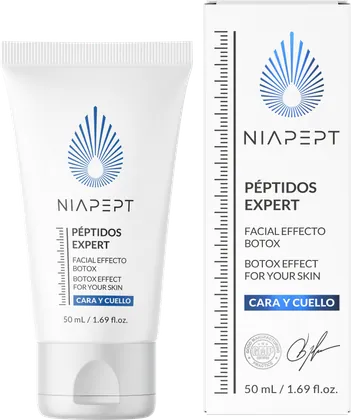
Niapept is a face and neck cream built on that combination, with argireline, niacinamide and hyaluronic acid plus calendula, vitamin E and aloe vera. You can read the Niapept product page or see what customers say in the Niapept reviews. Niapept is a topical cosmetic, not a supplement.
How do you read peptide names on an INCI ingredient list?
Peptides appear on U.S. cosmetic labels under their INCI names, which look technical but follow a pattern. The FDA requires ingredients on a cosmetic to be listed in descending order of amount, with ingredients under 1% free to appear in any order (see the FDA cosmetics page).
- Number words tell you the length: tripeptide (3 amino acids), pentapeptide (5), hexapeptide (6).
- A prefix such as “palmitoyl” or “acetyl” is a small chemical group attached to help the peptide blend with the skin’s oils.
- The number after the name distinguishes versions: palmitoyl pentapeptide-4, acetyl hexapeptide-8, copper tripeptide-1.
Tip: a peptide listed near the end of the ingredient list is present in a very small amount, which is normal, since peptides are used at low concentrations. Look also for “peptide complex” or “polypeptide” wording, which is a broader label that can cover several chains at once.
If you want to confirm what a name means, the full INCI name is the one to search; marketing names such as “Matrixyl” or “Argireline” are trade names for the INCI entries described above.
How can you use peptide products in everyday skin care?
Use peptides on clean skin, once or twice a day, and give them several weeks. A few practical habits make the difference.
- Order: cleanse, apply the lightest product first, then the cream, and finish with sunscreen in the morning.
- Start gradually: introduce one new product at a time and patch-test on the inner forearm for a few days first.
- Keep sunscreen daily: peptides support how skin looks, but sun protection is the habit that matters most.
- Moisturize the neck too: a face and neck cream covers the area many people forget.
- Be patient: take a photo in the same light every two weeks to judge the change fairly.
- Mind the neighbors: if you use a retinoid or an exfoliating acid, apply them at a different time of day from your peptide product, or on alternate nights, to limit irritation.
When should you see a dermatologist about your skin?
See a board-certified dermatologist if you have a mole that changes, a sore that lingers for weeks, persistent redness, rashes or itching, or acne that scars.
The same applies if a new product causes burning, swelling or hives; stop using it and ask a professional. A cosmetic cream is designed to support how skin looks and feels. It is not a treatment for a skin condition, and a dermatologist can tell you when something needs more than skin care.
General information only — not medical advice. Talk to your doctor or pharmacist about your situation.
Sources
- Wikipedia — Peptide
- Blanes-Mira C. et al. A synthetic hexapeptide (Argireline) with antiwrinkle activity. Int J Cosmet Sci, 2002
- Bissett D.L. et al. Niacinamide: a B vitamin that improves aging facial skin appearance. Dermatol Surg, 2005
- American Academy of Dermatology — How to test skin care products
- FDA — Cosmetics
More guides
- Prostate Supplements: What Is Inside and How to Choose One
- Nocturia in Men: Why You Wake Up to Urinate and What Helps
- Seven Foods Men Can Eat for Prostate Wellness
- Parasite Cleanse Explained: Herbal Formulas, Doctor Testing and Prevention
- How to Ease Bloating and Support Healthy Digestion
- Matcha or Coffee? A Side-by-Side Look at Your Morning Cup
- Green Tea, Matcha and Weight Management: A Practical Guide
- Making Matcha at Home: Step-by-Step for Every Style
- Joint Supplements Explained: Nine Ingredients and What Studies Say
- Glucosamine, Chondroitin, MSM and Boswellia: A Fair Comparison
- Why Are My Joints Stiff in the Morning, and What Can Help?
- Vitamin C for Collagen: How Your Body Builds It
- AREDS2 and Eye Vitamins: What the Research Studied, in Plain English
- Digital Eye Strain: Why Screens Tire Your Eyes and What Helps
- How Supplements Are Regulated in the U.S. and What Third-Party Testing Means
- Cold or Heat for Sore Muscles: A Practical Guide
- Sore After a Workout? What Muscle Soreness Is and How to Ease It
- How Muscle Rubs Work: A Plain-English Guide to Topical Relief
- Skin Care After 50: What Changes and What to Look For
- How to Read a Supplement Facts Label in Five Minutes
- Supplements and Medications: Five Interactions Worth Checking
- Ordering Supplements Online: A Practical Buyer’s Checklist